When We Stopped Believing in Anything Larger Than Ourselves.When we forgot we belonged to the God energy.

From Fabienne Price
Fabienne Price Therapy

We arrive in this world with a blank slate.
No name yet written. No sex declared. No colour assigned. No story told about us, no expectation loaded onto our small shoulders. Just a being, newly here, open to everything — and full, to the very brim, of love.
This is our original nature. Not something to be earned or constructed. Something we already were, before the world began its work on us.
I think about this often when I sit with someone in the consulting room.
The person across from me is not in the grip of a clear crisis. No bereavement, no accident, no visible rupture. Their life, by most external measures, is intact. And yet they are suffering — suffering from something that resists easy naming.
A pervasive flatness. A life that feels hollow even when it is comfortable. An anxiety without an object, rising from nowhere, settling nowhere. A loneliness that does not leave them even in the middle of a crowd, even in the arms of people who love them.
I have come to understand that this kind of suffering rarely begins where it appears to begin.
It begins before birth.
The moment a mother feels sustained stress — fear, grief, uncertainty, the chronic pressure of an unsafe world — her nervous system speaks directly to the body growing inside her. Cortisol crosses the placenta. The amniotic field changes. The child, not yet named, not yet breathing air, is already learning something about the nature of existence. Already receiving its first transmission: the world is not entirely safe.
This is not a failure of the mother. She is herself a carrier of what was passed to her. The transmission moves through generations like a current through water — invisible, continuous, older than anyone alive can remember.
Then the child arrives. And the programming continues.
In those early years, long before language can organise experience into a story, the child's body is absorbing everything. A harsh tone of voice. A withdrawal of warmth at the wrong moment. An atmosphere of tension that no one names but everyone feels. The unpredictability of a parent moving between tenderness and rage. The subtle but devastating message that love is conditional — that it must be earned through performance, through smallness, through the suppression of whatever is too much.
Fear leaves its mark on the nervous system. Threat contracts the body around itself. And love — real love, the unconditional kind, the child came in carrying — begins to feel dangerous. Too exposed. Too much to risk.
So the child adapts. It learns to manage. It builds, with extraordinary intelligence, a version of itself that can survive the particular world it has been born into.
And it carries that adaptation into adulthood. Into the consulting room. Into the life that looks fine from the outside.
I sit with all of this quietly before I ask anything. Then, when the moment is right, I ask gently whether they feel connected to anything larger than themselves. To God. To nature. To something they might call consciousness, or love, or simply mystery.
Most go quiet.
The pause is long.
Then they say some version of the same words.
"I don't really believe in anything like that."
And I listen to what lives underneath that sentence. Because it is not, as it first appears, the sound of certainty. It is not the calm of someone who has considered the question and settled it. It is grief.
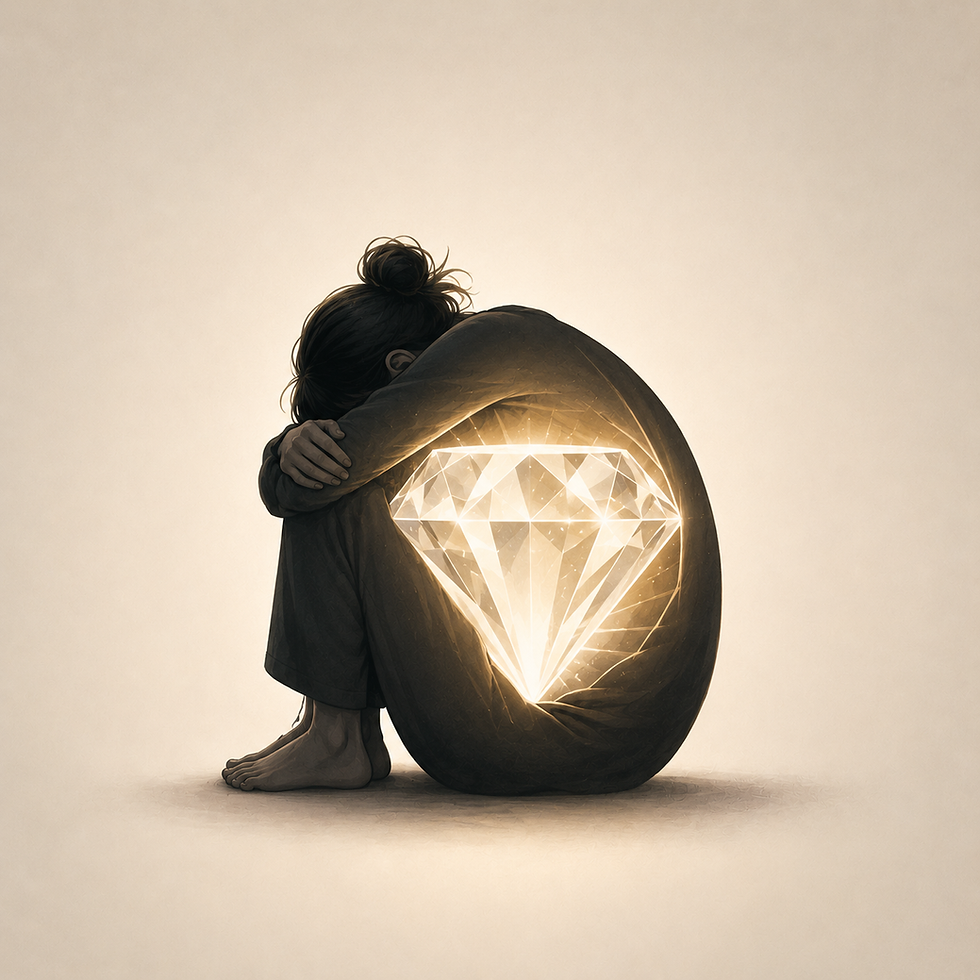
The grief of someone who arrived full — and somewhere along the way, through no fault of their own, was slowly, quietly, emptied.
The programming did its work. And the child forgot what they always knew at their core.
The Great Forgetting
We live in an era of extraordinary knowledge and extraordinary disconnection. We have mapped the genome, walked on the moon, and built machines that think. And yet, as a collective, we have never been more anxious, more depressed, more medicated, more lonely.
I do not think this is a coincidence.
For most of human history, and across virtually every culture on earth, people organised their inner lives around a felt relationship with something larger than the individual self. They called it by a thousand names — God, the Tao, Brahman, the Great Spirit, Allah, the Dreaming, the Field, Unconditional Love. The name was always less important than what it pointed toward: a living intelligence that permeates existence, a love that precedes thought, a belonging that does not have to be earned.
This was not merely superstition. The great contemplative traditions of East and West, when stripped of their dogmatic overlays, were extraordinarily sophisticated systems for one purpose: maintaining the individual's conscious connection to this deeper reality. Prayer. Meditation. Ritual. Sabbath. Fasting. Community. These were technologies of remembrance, practices that kept the thread of belonging from going dark.
In the last two centuries, under the pressure of scientific rationalism, consumer capitalism, and the digital saturation of attention, that thread has, for vast numbers of people, gone dark.
We did not replace it. We simply removed it.
And the suffering that has poured into the void is, I believe, among the most significant and least spoken-about public health crises of our time.
What We Lost When We Lost the Sacred
Let me be precise about what I mean by "God energy," because I am not speaking of any particular religion's God, and I am not asking anyone to adopt a creed.
I am pointing toward something that the mystic, the quantum physicist, the depth psychologist, and the long-term meditator each arrive at by different roads: the recognition that beneath the surface of ordinary consciousness, there is a field of intelligence, love, and wholeness that is not manufactured by the mind but discovered by it.
Carl Jung called it the Self — the organising principle deeper than the ego, the image of God in the psyche. Bruce Lipton, studying epigenetics, demonstrated that cells respond not merely to chemistry but to consciousness — that belief and perception alter biological reality at a molecular level. Joe Dispenza's work on neuroplasticity shows that sustained shifts in inner state can restructure the brain in measurable ways. The quantum physicists, confronting non-locality and the observer effect, speak of a field in which consciousness and matter are not as separate as we assumed.
What all of these points toward is the same insight that every genuine spiritual tradition has always known: the self is not confined to the skin. There is something in us that participates in something much larger.
When we lose contact with this — when we come to believe, as modern culture often insists, that we are isolated biological machines in a meaningless universe, producing and consuming until we die — the psychological consequences are profound.
The individual ego, which was never designed to carry the full weight of a person's meaning, sense of worth, and belonging, is asked to bear all of it. And it collapses. Not all at once, usually — but slowly, under the pressure of that impossible task.
Anxiety is the ego trying to control what it cannot control. Depression is the life force that has stopped believing in itself. Addiction is the desperate attempt to chemically reproduce a state of grace the person once knew but can no longer access. Narcissism is the ego inflated to compensate for the absence of anything it genuinely belongs to. Chronic emptiness — that peculiarly modern complaint — is simply what it feels like to be alive without a relationship to the depth of life.
Why People No Longer Believe
I hold enormous compassion for those who have lost their faith, or who never found it. The path to disbelief is often a path of integrity.
Many people left religion because religion hurt them. They were taught a God of punishment and exclusion, a theology of shame, a community that loved their performance more than their soul. They left, reasonably, because what was being offered in the name of the sacred was not sacred.
Others were formed entirely within the secular framework — educated into a worldview in which the question "is there something more?" was not dismissed with hostility but simply never asked. The mystery was not refuted. It was crowded out.
And others lost their sense of connection the way one loses a language when it is no longer spoken around them — not through rejection but through disuse. The inner life quietly closed, under decades of doing and producing, until one day they realised that something in them had gone very quiet.
None of these is a failure of character. They are the predictable consequences of living in a culture that has, with great sophistication, arranged itself to make depth almost inaccessible.
The phone that never rests. The algorithm that feeds the reactive mind. The economic system that reduces human beings to their output. The cities that have severed us from nature, from silence, from the night sky. These are not neutral. They are architectures of disconnection, and they function with remarkable efficiency.
How Therapy Can Become a Path of Return
I want to say something important here: I am not speaking about therapy as religious instruction. The therapeutic relationship must be a space of profound respect for each person's own truth. I would never impose a spiritual framework on someone for whom it does not resonate.
But what I have found, again and again, in the quiet space of the therapy room, is that when the conditions are truly right — when a person feels genuinely witnessed, unhurried, unjudged — something begins to happen that is not adequately explained by psychological language alone.
The person exhales. Not just their breath — their whole way of being. The vigilance softens. Something that has been bracing against the world for twenty or thirty years begins, very tentatively, to open.
This is not merely the result of good technique. This is what happens when a human being experiences — perhaps for the first time, or for the first time in years — that their authentic nature is safe. That they do not need to perform, manage, or justify their existence. That they can simply be, and still be met.
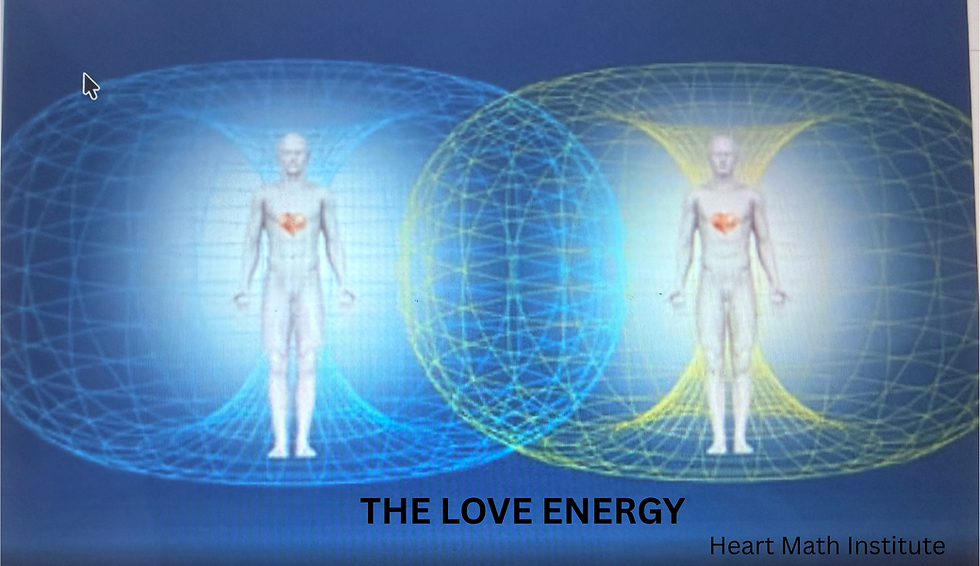
In spiritual language, this is an experience of unconditional love. In neurological language, it is the ventral vagal state — the felt sense of safety from which the deepest healing becomes possible. In quantum terms, one might say that two fields of consciousness have become coherent. The language matters less than the experience.
From this ground, several threads of deeper work become possible.
The first is what we might call the witnessing of the wound. Beneath the anxiety, the depression, the compulsive behaviour, there is almost always an early story: a child who learned that their authentic nature was too much, or not enough, and adapted by constructing a version of themselves that could survive. This adaptation — the ego, the mask, the false self — is not a failure. It was, in its time, intelligent. But it exacts a cost. It keeps the person at a safe distance from their own depths. And it keeps them at a safe distance from life.
When therapy creates a space large enough and safe enough that the original wound can be spoken aloud, something remarkable often occurs. The wound, so long kept in the dark, turns out to be survivable in the light. The grief that was never grieved can finally be felt. The rage, the shame, the longing — these, when received by an attentive, unfrightened witness, begin to metabolise. The frozen places in the psyche begin to thaw.
This is the beginning of returning to one's own nature. Not because the wound is erased, but because the person no longer has to spend all their energy keeping it hidden.
The second thread is what Jung called shadow integration. Every aspect of ourselves that was judged unacceptable — by our families, our cultures, our own frightened inner critic — gets pressed into the unconscious. It does not disappear. It festers. It leaks out sideways in projections, compulsions, physical symptoms, and the particular flavour of our suffering.
When therapy makes it possible to turn toward these exiled parts with curiosity rather than condemnation, the energy that was locked in suppression becomes available. People find themselves more alive, more creative, more present. They begin to move differently through the world — less defended, less reactive, more genuinely themselves.
And it is here — in the experience of being more genuinely oneself — that the reconnection to something larger often quietly arrives.
The third thread is the invitation to the body. The disconnection from God energy is not only a psychological event. It lives in the body — in the bracing of the chest, the held breath, the chronic tension of the throat. The body carries the memory of separation in its tissues.
Somatic practices — breath, movement, the gentle tracking of sensation — are among the most direct portals back to the present moment. And the present moment, as every contemplative tradition has always known, is the only place where the deeper reality can be encountered. We do not find God — or consciousness, or love, or whatever language fits — in our thoughts about the past or our fears about the future. We find it here. Now. In this breath. In the felt sense of being alive in this body, in this moment.
The fourth thread, which not every client is ready for, is the explicit cultivation of a personal relationship with the mystery. This does not require religion. It does not require adopting anyone else's framework. It requires only a willingness to be curious — to ask, perhaps for the first time: Is there something more? What happens when I am genuinely still? What do I encounter when I stop filling every silence?
For some people, this leads back to a tradition they had left but still love, now experienced differently — not as an obligation or performance, but as a genuine relationship. For others, it becomes a daily practice of silence, of time in nature, of prayer in whatever words are their own. For others still, it is simply the cultivated capacity to be present — to live, more and more often, in contact with the aliveness of this moment rather than the noise of the conditioned mind.
A Word to Those Who Cannot Believe
If you have read this far and find yourself resistant — if the language of God or consciousness or unconditional love feels foreign, or contaminated by association with things that hurt you — I want to speak directly to you.
You do not need to believe anything.
You only need to notice whether you have ever, even briefly, felt something that no ordinary word quite captures: a moment of profound stillness in nature, an experience of love that asked nothing in return, a moment of creative flow in which the usual sense of a separate self seemed briefly to dissolve, a grief so complete that it cracked something open rather than closing it.
If you have ever felt any of these things, you have, in your own language, touched what I call the source. It is not owned by any religion. It is not reserved for the devout. It is the ground of your own being — and it is available to you, not as something to be believed but as something to be met.
Therapy, at its most alive, is not just the repair of a broken mind. It is the gradual, gentle, deeply respectful process of bringing a human being back into contact with their own depths — and through those depths, with the love that has been holding them all along without their knowing.
The door to the home is never locked from the outside.
It is simply that, for a very long time, many of us have forgotten it was there.
You do not have to be certain of anything. You only have to be willing to be still.